Department of Geography
Directory
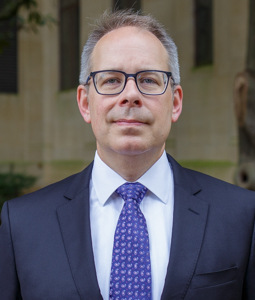
Carl T. Dahlman
| Title: | Interim Associate Dean for Interdisciplinary Programs, Institutes, and Academic Centers Executive Director, Walker Institute of International and Area Studies |
| Department: | Geography College of Arts and Sciences |
| Email: | carl.dahlman@sc.edu |
| Phone: | 803-777-4558 |
| Resources: | Curriculum Vitae [pdf] |
Bio
Carl T. Dahlman, Ph.D., is a political geographer whose research centers on the collision of geopolitics and lived reality. Dahlman started at USC in 2001 and left in 2006 for Miami University, where he directed a large interdisciplinary International Studies program. He returned to USC in 2022 where he is currently the Executive Director of the Walker Institute of International and Area Studies. He also serves as interim Associate Dean in the McCausland College of Arts and Sciences. Dahlman has received commendations for teaching excellence, and he has offered a wide range of courses on global topics in both disciplinary and interdisciplinary curricula including courses on refugee studies, population and migration, political geography, global economic relations, and geopolitics, as well as introductory and capstone courses. He directs a study abroad program to Kosovo, where he has taught students since 2008. His research may be organized under three themes.
Post-war reconstruction and peacebuilding. Earlier research focused on the effects of armed conflict on human populations, especially the dynamics of ethnic cleansing/genocide and forced migration on post-war reconstruction processes in the former Yugoslavia and Middle East. This fieldwork was funded by the National Science Foundation and other sources, and these publications include a detailed co-authored book on post-war Bosnia in addition to over 40 articles and book chapters. Dahlman’s work has appeared in French and Serbo-Croatian. He is currently writing two books about Kosovo, one about the compound socio-political transition of Europe’s newest country and the other about the temporalities of its cultural landscapes.
Risk, society and civil defense. European formulations of risk, security, and solidarity are undergoing a historic transformation in the context of Russia’s expanded war in Ukraine, climate crises, populist political movements, and deteriorating relations with the guarantors of Euro-Atlantic security. How are national and local socio-political communities contending with changing risks arising from this historic shift in security arrangements and regional dynamics? Drawing from fieldwork across central and eastern Europe, this research investigates the effects of geopolitical transformation on local risk perception, disaster planning, and political culture. What role do past disaster management practices and civil defense plans have on assessing changing risks? How are these risks and uncertainties framed and understood by publics? What affect do these risks responses have on social and political identities and solidarities?
De/re-territorialized authoritarianisms. Authoritarian practices are not limited to national governments nor constrained by sovereign territorial boundaries. Local governments, infrastructural actors, private and traditional agents, and corporate entities pluralize the sites and purposes of authoritarian practice. Central governments, meanwhile, pursue extraterritorial practices, often by repurposing the tools and techniques of globalization. Digital communications, transboundary flows, and economic policies have become highly effective means by which authoritarian actors gain compliance from putatively liberal counterparts. Current work closely examines authoritarian actors’ use of legal cooperation such as extradition, bilateral deportation agreements, and migrant surveillance to extend authoritarian state interests beyond their borders.
Select Publications
Cutter, Susan and Carl T. Dahlman (accepted) “Insecurity and Impacts of Cascading and Compounding Climate-Sensitive Hazards,” Proceedings of the National Academy of Sciences.
Dahlman, C.T. and C. Gallaher. (2024). “Of Chakras and Shock-troops: Insurrectionary affinities to alternative religious movements.” Antipode.
Riding, J. and C.T. Dahlman. (2022). “Montage space: Extra Scenes.” Dialogues in Human Geography. 12(2): 278–301. DOI: 10.1177/20438206221107026
Riding, J. and C.T. Dahlman. (2022). “Montage space: Borderlands, micronations, terra nullius, and the imperialism of the geographical imagination.” Dialogues in Human Geography. 12(2): 321–325. DOI: 10.1177/20438206221102597
Dahlman, C.T. (2022). “Embedded Authoritarianism: The Construction of Local Ethnocracy in Bosnia and Herzegovina,” in N. Koch, ed., Spatializing Authoritarianism, Syracuse, N.Y.” Syracuse University Press.
Dahlman, C.T. (2019). “National Pasts and Biopolitical Futures in Serbia,” in M. England, M. Fannin, and H. Hazen, eds., Reproductive Geographies: Bodies, Places and Politics. New York, N.Y.: Routledge, 184-200.
Dahlman, C.T. and Sanan Moradi (2018). “Kurdistan on the Line: Partition and National Fragmentation,” in G Herb and D Kaplan, eds., Nested Identities, 2nd ed. Boulder, Colo.: Rowman and Littlefield, 223-237.
Toal, G. and C.T. Dahlman (2011). Bosnia Remade: Ethnic Cleansing and its Reversal. Oxford University Press.
S. Rosière, C. Dahlman, K. Cox, and C. Machiani-Marcuzzo, eds. (2009). Penser l’espace politique. Paris: Editions Ellipses.